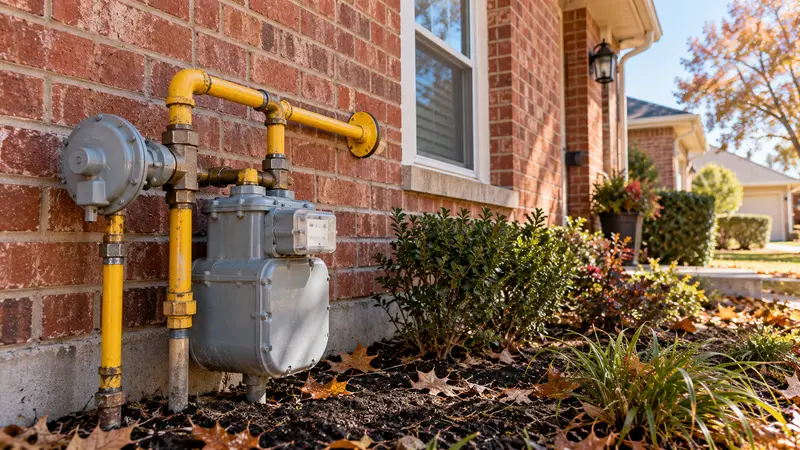
Every fall, Dallas homes switch on furnaces, gas heaters and gas fireplaces for the first time in months. That is a good moment to know the signs of a gas leak in your house. A leak at the Alexan Riveredge apartments on Turtle Creek Boulevard in September 2026, which NBC 5 reported sent hundreds of residents out of their homes, was a reminder of how quickly a gas problem becomes everyone's problem.
Short answer: the main signs of a gas leak are a rotten-egg smell, a hissing or roaring sound near a gas line or appliance, and visible clues such as bubbling in wet ground, dirt blowing up from the ground or dead plants over a buried line. If you notice any of them, leave the house first, then call 911 and Atmos Energy at 866.322.8667 from a safe distance. Do not try to find the leak yourself.
Sign 1: a rotten-egg or skunk-like smell
Natural gas has no smell on its own. Atmos Energy adds an odorant called mercaptan so a leak can be noticed, and it says people describe the odor as rotten eggs or skunk. Federal and state rules require gas to be odorized so it is readily detectable by a person with a normal sense of smell.
The smell may be strongest near the kitchen range, the water heater, the furnace closet, a gas dryer, or outside near the meter. A faint smell that comes and goes is still a reason to act.
Sign 2: a sound you do not normally hear
Atmos Energy tells customers to use all their senses: smell, listen and look. The U.S. Pipeline and Hazardous Materials Safety Administration (PHMSA), the federal pipeline safety agency, says the sound of a leak can range from a quiet hissing to a loud roar depending on the size of the leak. Listen near gas appliances, the connector behind the stove or dryer, the meter, and where a gas line enters the house. A sound like that with no obvious cause is a warning sign even if you smell nothing.
Sign 3: something you can see
Look at the area around the meter and the path of any buried gas line in the yard. PHMSA lists visual signs of a gas leak such as:
- Dirt blowing around the area of a buried line
- Continuous bubbling in wet or flooded ground
- Dead or discolored plants in an otherwise healthy area
- Abnormally dry soil, or frozen ground in warm weather
Atmos Energy also says buried piping on your property should be inspected periodically, because piping that is not maintained can corrode and leak.
Atmos also advises: if a meter is damaged or a gas line is exposed, leave the area and call its 24-hour emergency line.
You may not always smell it
Do not rely on smell alone. Atmos Energy notes that continued exposure to the odorant can dull your sense of smell and that other odors in the room can mask it. Some people also have a weaker sense of smell. Atmos says residential methane detectors are available as an extra layer of warning, but a detector is never a reason to ignore other signs.
What to do right now if you suspect a gas leak
Atmos Energy's guidance is clear: do not wait.
- Leave the house immediately. Take people and pets with you. Do not delay your exit to open doors or windows.
- Call from a safe distance. Once you are well away from the house, call 911 and Atmos Energy at 866.322.8667. Atmos Energy says it will send a trained technician to investigate.
- Do not assume someone else will report it. Atmos asks every person who notices a leak to call.
What not to do
- Do not look for the source of the leak. Atmos Energy says never to try to find it yourself.
- Do not create a spark. Atmos warns not to use a mobile phone or anything that might cause a spark until you are at a safe distance. PHMSA's list adds: do not light a match or create any open flame, do not use an electrical switch or pull plugs from outlets, do not open an automatic garage door, and do not start vehicles or electrical equipment. To warn neighbors, knock with your hand instead of ringing a doorbell.
- Do not turn off the gas at the meter. Atmos tells customers not to shut off natural gas at the meter, even if evacuations are issued.
- Do not go back inside until Atmos Energy or the fire department says it is safe.
A gas leak is not the same as carbon monoxide
People sometimes mix these up. A gas leak is unburned natural gas escaping from piping or an appliance. Carbon monoxide (CO) is produced when fuel burns, for example in a furnace or a gas range that is not working right. The CDC describes CO as an odorless, colorless gas and lists headache, dizziness, weakness, upset stomach, vomiting, chest pain and confusion as the most common symptoms. Because you cannot smell it, the CDC recommends battery-operated or battery back-up CO detectors near every sleeping area, and yearly service of gas-burning appliances by a qualified technician.
Who fixes the leak after the area is safe?
Atmos Energy maintains the meter and its own lines. Inside your property line, the responsibility changes. Atmos says that in most states, including Texas, the customer owns the natural gas piping on their property from the gas meter to the home and its appliances, and that Atmos does not maintain the lines beyond its meter.
If Atmos Energy shuts off or restricts gas because the leak is on your side of the meter, the next step is to contact a plumber who works on gas piping. The plumber can inspect the customer-owned piping and repair or replace the affected section. Contact Atmos Energy about the steps required before gas service is restored. Our page on gas line repair in Dallas explains what that repair involves, and if a water heater's gas connection was part of the problem, see water heater repair in Dallas.
Before you turn the heat on this season
- Know where your gas meter is, as Atmos recommends.
- Make sure there is a working CO detector near every sleeping area.
- Have the furnace, water heater and other gas appliances serviced, as the CDC advises once a year.
- If you have a buried gas line to a pool heater, grill, outdoor kitchen or detached garage, have it inspected, since Atmos says buried customer piping can corrode and leak over time.
Need a plumber in Dallas?
If Atmos Energy has made the area safe and the gas piping on your side of the meter needs repair, call now at (877) 340-0703 and describe what was found. Calls are answered 24/7. For urgent plumbing problems, see our emergency plumber in Dallas page, and check the Dallas zip codes we serve to confirm your area.
Sources
- Recognizing a Leak (Atmos Energy)
- Homeowner Safety (Atmos Energy)
- Safety Information for Natural Gas Contractors and Professionals (Atmos Energy)
- Atmos Energy Urges Natural Gas Safety After Severe Weather (May 29, 2024) (Atmos Energy)
- Pipeline Leak Recognition and What to Do (U.S. Pipeline and Hazardous Materials Safety Administration (PHMSA))
- Carbon Monoxide (CO) Poisoning Basics (CDC)
- Hundreds displaced by gas leak at Dallas apartment complex (Sept. 19, 2026) (NBC 5 Dallas-Fort Worth)
This guide is general information for Dallas homeowners, not a substitute for a plumber inspecting your home.