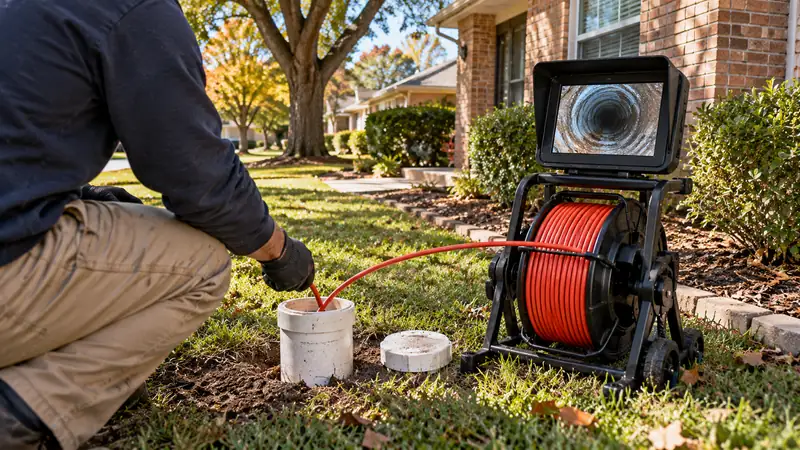
Trenchless sewer repair is a way to fix or replace a damaged sewer line without digging a trench along its whole length. Instead, the work is done through one or two small access points, such as a cleanout near the house or a small pit in the yard. For a Dallas home where the sewer line runs under a driveway, a patio or mature trees, that can mean far less digging and repair afterward.
Short answer: the two main trenchless methods are pipe lining (a new pipe is formed inside the old one) and pipe bursting (the old pipe is broken apart while a new one is pulled into its place). Neither fits every pipe. A camera inspection should show whether your line is a good candidate before anyone agrees on a method.
How does trenchless sewer repair work?
Pipe lining (CIPP)
Cured-in-place pipe lining is the method most homeowners mean by "trenchless." According to NASSCO, the trade association for sewer rehabilitation, a flexible tube is soaked in resin and pulled or inverted into the existing pipe, then cured in place using hot water, steam, hot air, ambient temperature or light. Once hardened, the liner becomes a new, seamless pipe inside the old one, covering cracks and open joints.
NASSCO says lateral lining is suitable when the existing pipe has generally kept its original shape. It also states that a properly designed, installed and tested lateral liner has a minimum life expectancy of 50 years.
Pipe bursting
Pipe bursting replaces the old pipe instead of lining it. NASSCO describes the existing lateral being broken apart by fracturing or splitting while a new pipe of the same or larger diameter is pulled in behind it. This method typically needs an access pit at each end, but still avoids a trench along the full run.
When trenchless sewer repair is not the right fix
Trenchless methods have limits, and a good plumber should tell you when yours is one of those cases. NASSCO's rehabilitation matrix lists these:
- Collapsed or crushed pipe. For lining, the existing pipe must be clear of obstructions and not crushed or collapsed.
- Severe sags (bellies). Rehabilitation keeps the existing line and grade, so a liner follows the same dip where waste settles.
- Badly deformed pipe. Lining is not recommended where the pipe has lost a large part of its cross-section.
- Odd shapes or many connections. Pipe bursting is not suitable for non-round pipe or runs with multiple service connections.
In those cases, traditional excavation of the damaged section is often the better answer, sometimes combined with lining the rest of the line.
Why Dallas sewer lines end up needing repair
Sewer lines can develop cracks, separated joints or other damage as they age. Tree roots can enter existing cracks and joints, while a sag in the line can allow waste and water to collect. The cause in a particular Dallas home depends on the pipe's material, condition and installation. Our page on sewer line repair in Dallas explains common causes and repair options.
If you are seeing slow drains in several fixtures or a backup in the lowest drain, the problem may be a clog rather than a broken pipe. Drain cleaning in Dallas is often the first step, followed by a camera inspection if the problem keeps coming back.
Questions to ask before anyone digs
Before you agree to any sewer repair, trenchless or not, ask:
- Can I see the camera footage? You should see where the damage is, what it looks like and how long the damaged section is.
- Is my pipe a candidate for lining, bursting or neither, and why? Ask them to point out sags, breaks or collapsed spots on the video.
- Where will the access points be? Know exactly what will be opened in your yard, driveway or floor.
- What liner or pipe material will be used, and how is it tested? NASSCO's life-expectancy figure assumes proper design, installation and testing.
- Will the line be inspected on camera again afterward? A final video shows the finished work.
- Does this job need a City of Dallas permit, and who pulls it? The city's Building Inspection division handles plumbing permits and inspections.
- What is the plan if the camera finds something unexpected? Ask how changes to the plan will be explained and approved before more work is done.
If a sewer problem shows up along with a high water bill or warm spots on the floor, the issue may be a water line under the slab instead; see slab leak repair in Dallas. And if your house smells like sewage while you wait for repairs, our guide on why a house smells like sewer explains what to check.
Need a plumber in Dallas?
If your sewer line is backing up, gurgling or smelling, call now at (877) 340-0703 and describe what is happening. Calls are answered 24/7. See the Dallas zip codes we serve to check your area.
Sources
- Pipe Rehabilitation (NASSCO (National Association of Sewer Service Companies))
- Pipeline Rehabilitation Matrix 2025 (NASSCO)
- Plumbing/Mechanical Inspections (City of Dallas, Building Inspection)
This guide is general information for Dallas homeowners, not a substitute for a plumber inspecting your home.