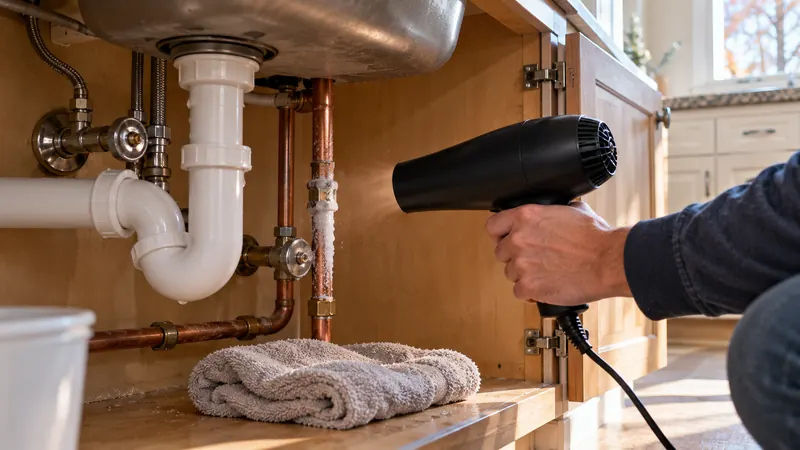
If your faucet only trickles on a cold morning, here is what to do if pipes freeze: keep the faucet open, find your main water valve, warm the pipe slowly with a safe heat source and then check for leaks once water flows again. Water expands as it freezes, and that pressure can split a pipe, so the order of those steps matters.
Short answer: keep the affected faucet open while thawing, never use an open flame, and do not assume the pipe is sound just because it thawed. A frozen pipe may already be cracked and can start leaking as the ice melts. This guide covers the steps in order, using advice from the American Red Cross, Texas A&M AgriLife Extension and Dallas Water Utilities. If you are still trying to prevent a freeze, read our checklist on how to winterize pipes in Dallas first.
Step 1: Confirm the pipe is frozen
The Red Cross says to suspect a frozen pipe if you turn on a faucet and only a trickle comes out. Check more than one tap. If every faucet is dry, the problem may be the main line or the meter instead of a single pipe.
Look first in the places that freeze most often:
- Pipes along exterior walls with little or no insulation.
- Pipes in an attic, garage, crawl space or unheated corner of the house.
- The spot where the water line enters the house through the foundation.
- Outdoor hose bibs and sprinkler lines.
Texas A&M adds that a hot-water line can freeze just like a cold one if water is not moving through it. According to the same guide, pipes can freeze and burst when the outside temperature reaches 20°F or below.
Step 2: Know where your main water valve is
Before you warm anything, find the main shut-off valve. Texas A&M's advice is blunt: the frozen pipe may already be broken, and it will leak when the water thaws. If it does, the main valve has to be closed until the leak is repaired.
If you cannot find your valve, or a pipe has already burst, Dallas Water Utilities says to call 3-1-1 and ask for emergency help turning the water off at the meter. From January 13 to 17, 2024, during the arctic blast, DWU reported 728 winter weather meter calls. Expect a wait during a hard freeze, so if you can reach your own shut-off valve, close it first.
Step 3: Leave the faucet open and warm the pipe
Open the faucet the pipe feeds and leave it open. The Red Cross explains that water begins to flow through the frozen area as it melts, and that running water helps melt the rest of the ice.
Then apply gentle heat to the frozen section. The Red Cross and Texas A&M list these safe options:
- An electric heating pad wrapped around the pipe.
- An electric hair dryer.
- A portable space heater, kept away from anything that can burn.
- Towels soaked in hot water wrapped around the pipe.
Keep electrical cords and the hair dryer away from standing water. Keep applying heat until full water pressure returns.
What not to use
Do not use a blowtorch, kerosene or propane heater, charcoal stove or any other open flame. Texas A&M warns these are a serious fire hazard and release carbon monoxide. A pipe inside a wall or ceiling you cannot see is a good reason to stop and call a plumber instead of improvising.
Step 4: Check every other faucet
Both the Red Cross and Texas A&M say the same thing: if one pipe freezes, others may freeze too. Once one tap runs again, walk through the house and test the rest, including bathrooms, the kitchen, the laundry and outdoor spigots. A second frozen line is easy to miss until it splits.
Step 5: Check for leaks after the thaw
Watch for these signs while the pipe thaws and for the next few hours:
- Water dripping or spraying from the thawed pipe or its joints.
- A wet ceiling, wall or cabinet near where the pipe runs.
- The sound of running water when every fixture is closed, or a water meter that keeps moving with everything off. Either means water is escaping somewhere.
If you find water, close the main valve and call a plumber. Our page on emergency plumber service in Dallas explains what to expect when a pipe has split. If your home keeps losing pipes in cold snaps, pipe repair and repiping in Dallas covers when a repair is enough and when old lines should be replaced.
When to call a plumber instead of thawing it yourself
Call a plumber right away if:
- You cannot find or reach the frozen section. The Red Cross says to call a plumber in that case, and also if the pipe will not thaw.
- The pipe is already split or water is showing anywhere.
- The frozen line is inside a wall, ceiling or under a slab.
- You are not comfortable working near water and electricity.
A water heater that sat in a cold garage or attic can be damaged by a freeze as well. If you see moisture at its fittings or no hot water after the freeze, see water heater repair in Dallas.
Who handles what in Dallas
According to Dallas Water Utilities, property owners are responsible for all private plumbing between the home and the water meter, while DWU is responsible for the meter and the water system on the street side of it. That means a burst pipe inside your house or yard is yours to repair, but a problem at or beyond the meter is for the city to handle.
Need a plumber in Dallas?
If a pipe has frozen, split or started leaking, shut off the main valve if it is safe, then call now at (877) 340-0703 and describe what you see. Calls are answered 24/7. Not sure your zip code is covered? See the Dallas areas we serve.
Sources
- Preventing & Thawing Frozen Pipes (American Red Cross)
- Winter Storms: Preventing and Thawing Frozen Pipes (Texas AgriLife Extension Service, Texas A&M University System)
- DWU addresses impacts to water mains and pipes due to winter weather (January 17, 2024) (Dallas Water Utilities, via Dallas City News)
This guide is general information for Dallas homeowners, not a substitute for a plumber inspecting your home.